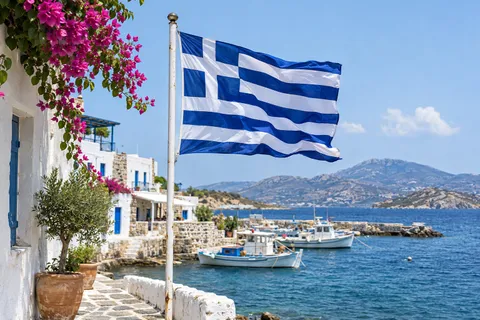
Residency in Greece

Ways of Getting a Residency in Greece
Below, you can familiarize yourself with the brief characteristics of the main ways of getting Greece permanent residency:
- Greek ancestry. If at least one of your parents or grandparents is of Greek origin, you may be allowed to live and work in this country. Get in touch with your local diplomatic mission to discuss repatriation opportunities. Otherwise, you may try to prove the ancestry of some other EU state. First, you get the residency of that state and relocate to Greece in a while. Every case of proving ancestry is highly individual, so please discuss yours with a legal expert.
- Through marriage. You may tie the knot with either a Greek or a person who was born elsewhere but has received Greek citizenship later. The local authorities have nothing against same-sex marriages, so this state can be classified as an LGBTQ-friendly one.
- The investment card is tied to a qualifying asset, not to any €250,000 purchase. For the €400,000 and €800,000 zones that means one home of at least 120 m². A bare plot or a stack of small units does not meet that test. Spain no longer runs a property Golden Visa. Greece still does not ask you to live in the country in order to renew, but selling the asset ends the status — there is no “get the money back in five years and keep the card” rule.
- Independent financial means, also known as the National D visa. That should be an optimal approach for retired expats or those who work remotely. For younger individuals, it might be trickier to get it, compared to the ones aged 65 or older. You'll need to convince the officials that you are a well-off person who can stay permanently in Greece without being employed there. If you have not reached the retirement age yet, you'll need to provide more papers and answer more questions to explain that you can sustain yourself without work. Each month, you should earn at least €2,000 from sources registered elsewhere in the world. Plus, you need to have €24,000 in your bank account (or an equivalent to this sum in a foreign currency). Upon arrival in Greece, be ready to open an account in a local bank. The larger the sum of your savings and the more stable your income, the higher your odds of getting approval. With a National D visa, you'll need to spend at least 183 days per year in Greece. The process of getting this type of permit might be more time-consuming and complicated than obtaining a Golden Visa.
- Student/Trainee Visa. First, you should enter a Greek university and once you're sure you've made it, apply for a student visa. The main difference between the trainee visa and the student one is that the former enables you to enroll for short-term courses that last for a few months or no more than a couple of years. To get to know the exact opportunities of applying for the trainee visa, visit the Greek embassy or consulate in your area.
In all these cases, you have a right to prolong your permit not once but for an unlimited number of times. To avoid penalties, you should apply for a new permit before the current one expires. If your papers have expired but you don't apply for new ones for a month or longer, you risk losing your residency. In case of pandemics or other emergencies, the authorities offer more flexible deadlines.
Apart from the above-mentioned variants, you might consider some other alternatives — but they are not so popular. For instance, you might launch a business on Greek territory with a capital of €300,000. Otherwise, you might consider investing €400,000 in the following types of assets:
- Greek shares or Treasury bonds, listed on the Greek Stock Exchange;
- Shares of real estate investment companies, venture capital companies or alternative investment funds that invest exclusively in this country;
- A 1-year deposit with permanent extension prolongation.
You will be allowed to sell the assets or close the deposit in five years. With certain types of bonds, the minimum necessary sum might be higher than €400,000, so you should discuss this aspect with an expert.
To use these investment options, you should have enough savings and certain financial expertise. To register a company in Greece, it's essential to understand the specifics of the local business environment.
If you would prefer to land a job in Greece, you should realize that the unemployment rate here is consistently high. Greek companies would hire you only if you have some particular skills and experience that locals lack.
In this article, we won't focus on relocation together with your relatives. But if you belong to the category of well-off expats, you should be able to take your family with you rather easily.
Please mind the difference between a long-term residency and citizenship. To obtain the latter, you should live in this state permanently for seven years. You might get Greek citizenship in three years after the relocation if you:
- Are an EU national;
- Are a political refugee;
- Have a child with a Greek who is your legal spouse;
- Have custody of a Greek.
You'll need to pass the exam to show that you speak fluent Greek. Plus, you should be socially and economically involved in local life. Ethnic Greeks can obtain citizenship by studying at the National Military Academy or serving in the local Armed Forces.
Only thanks to citizenship, you get a right to receive social benefits for Europeans and easily obtain resident status in any European state. Plus, your kids will inherit your Greek citizenship — but they would fail to inherit the residency. Without citizenship, you can still get access to local medical services and education, open an account in a European bank and travel freely across Europe.
Greece recognizes dual citizenship, so it won't force you to renounce the citizenship of another state. However, you might need to renounce the citizenship of another state if its legislation fails to support dual citizenship.
Eligibility Criteria
To apply for a long term residence permit in Greece, you should:
- Come of age (18+);
- Have no criminal record;
- Pose no threat to the national security and the health of the surrounding people;
- Get health insurance;
- Prove that you own or rent a house or apartment on Greek territory.
Your housing doesn't need to be large: it's enough to have 9 square meters per person.
Fees
When applying for a Greek residency, you should be ready to pay the following fees.
- The government fee for a single applicant: €2.000
- Wife or husband/Parents/Kids aged 13+: €150
- Permanent residency card: €16
- Electronic residence permit fee: €16
- Insurance Fee: €100 to €200
- ENFIA, the annual property tax, is worked out mainly from size, zone, age and cadastral value, in a range of about €2 to €16 per square metre. From 2025 a dwelling worth up to €500,000 can get a 20% reduction if it was insured against natural disasters.
- Property transfer tax: 3.09% (not payable if VAT is applied)
- Stamp duty (transactions between individuals): 3.6%
- Transaction costs (notary, etc.): 1–2%
- Special tax: 15% (only if the beneficiary is not disclosed)
- VAT for purchasing a new property: 24%
The exact list of fees and the sums that you'll need to pay might vary depending on your way of getting the residency. They can also change over time. For VAT purposes, "new property" denotes houses, apartments and commercial buildings whose construction permit was issued after 1 January 2006. Under Law 5162/2024, capital gains tax on private sales of real estate remains suspended until 31 December 2026. Rental income for individuals is taxed on its own scale for tax years up to 2025: 15% on the first €12,000, 35% on the next €23,000 (up to €35,000), and 45% above €35,000 — confirm the year's bands before filing.
Documents
A financially independent person who wants a residence in Greece needs a visa of type D and the following papers:
- Application;
- Black-and-white passport-style photos (printed and digital);
- Certified copy of the passport;
- State duty in digital format;
- Health insurance agreement;
- Proof of a stable annual income plus the fact of having enough savings;
- Lease or sales contract for a house or apartment.
The permit will expire in two years but you'll have a right to prolong it for three years.
Those who would like to receive the Golden Visa should get a Greek Schengen Visa and the following papers:
- Application;
- Passport-style photos;
- Passport (plus its copy);
- Proof of having sufficient savings and the fact of having paid the fees;
- Health insurance.
Plus, be ready to attach the papers that prove the fact of purchasing a house, apartment or commercial building, renting an object of tourism infrastructure or investing in a local company.
If you tie the knot with a Greek, you may get a marriage license either in Greece or abroad. If this document was issued abroad, it should not state that it is valid exclusively in the issuing jurisdiction.
Students should provide acceptance letters from their universities.
All the documents from the package that you submit should be in Greek.
Travel Destinations for Greek Residents
After getting the residence permit in Greece, feel free to move all over Europe! Typically, you'll have a right to spend up to 90 days in one state. Yet in certain states, you should count these 90 days starting with the date of your arrival — and in the others, you'll be able to distribute these 90 days during 180 days, starting with the date of your arrival. It would be wise to check the legislation of each state individually before setting out on a trip. Be ready to present a valid ID or passport upon arrival for identification purposes.
If you're planning to head to the Americas and the Caribbean, you should be able to spend from 30 to 180 days in a destination that belongs to any of these regions. You won't need a visa for most countries. However, when heading to the US or Canada, you'll need to get an ETA (Electronic Travel Authorization) that remains valid for 2 or 5 years, respectively.
As for Asia, Africa, Oceania and other territories, you'll be allowed to visit most states without a visa. In slightly over 30 states, customs officials will put a visa stamp in your passport upon arrival. Only Sri Lanka, Vietnam, Australia, New Zealand, Guam, Northern Mariana Islands, U.S. Virgin Islands, Norfolk Island, Puerto Rico, U.S. and Canada require Electronic Travel Authorization — but it should take you very little time and effort to apply for this type of permit.
We compare locations, check properties and support your purchase in English.
5 locations
Athens · Thessaloniki · Halkidiki · Peloponnese · Crete
One contact
from the first enquiry to the keys
Full budget
before you reserve a property
In English
property selection and deal support